How Brazil’s schools are turning children’s faces into data
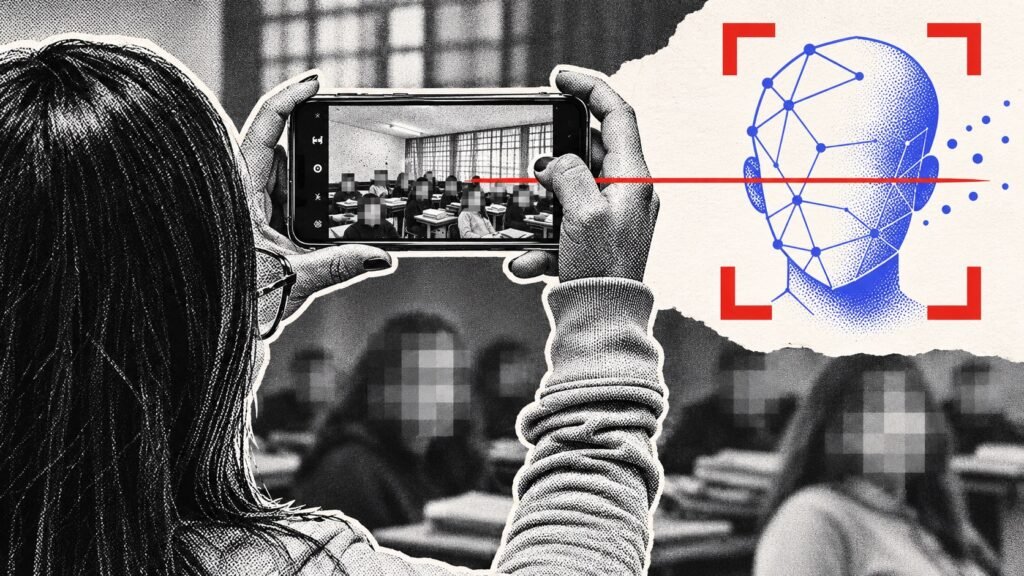
Brazil’s Ministry of Education advised against the mechanism; the National Data Protection Authority (ANPD) has suspended the bid in one state. Elsewhere, local authorities continue to purchase the mechanisms. Two tenders reviewed by Intel Focus do not indicate the existence of safeguards regarding the storage or deletion processes of children’s data.
On 22 Sept. 2026, Várzea Alegre, a small town in north-eastern Brazil, opened bids for a biometric system licensed for 5,000 pupils, whose faces would be photographed by webcam and scanned at the school gate. Its tender says the data will be stored ‘local and in the cloud’ and can be copied between devices ‘through a USB drive’.
Seven weeks earlier, Brazil’s National Data Protection Authority (ANPD) had suspended a similar biometric system in the state of Paraná.
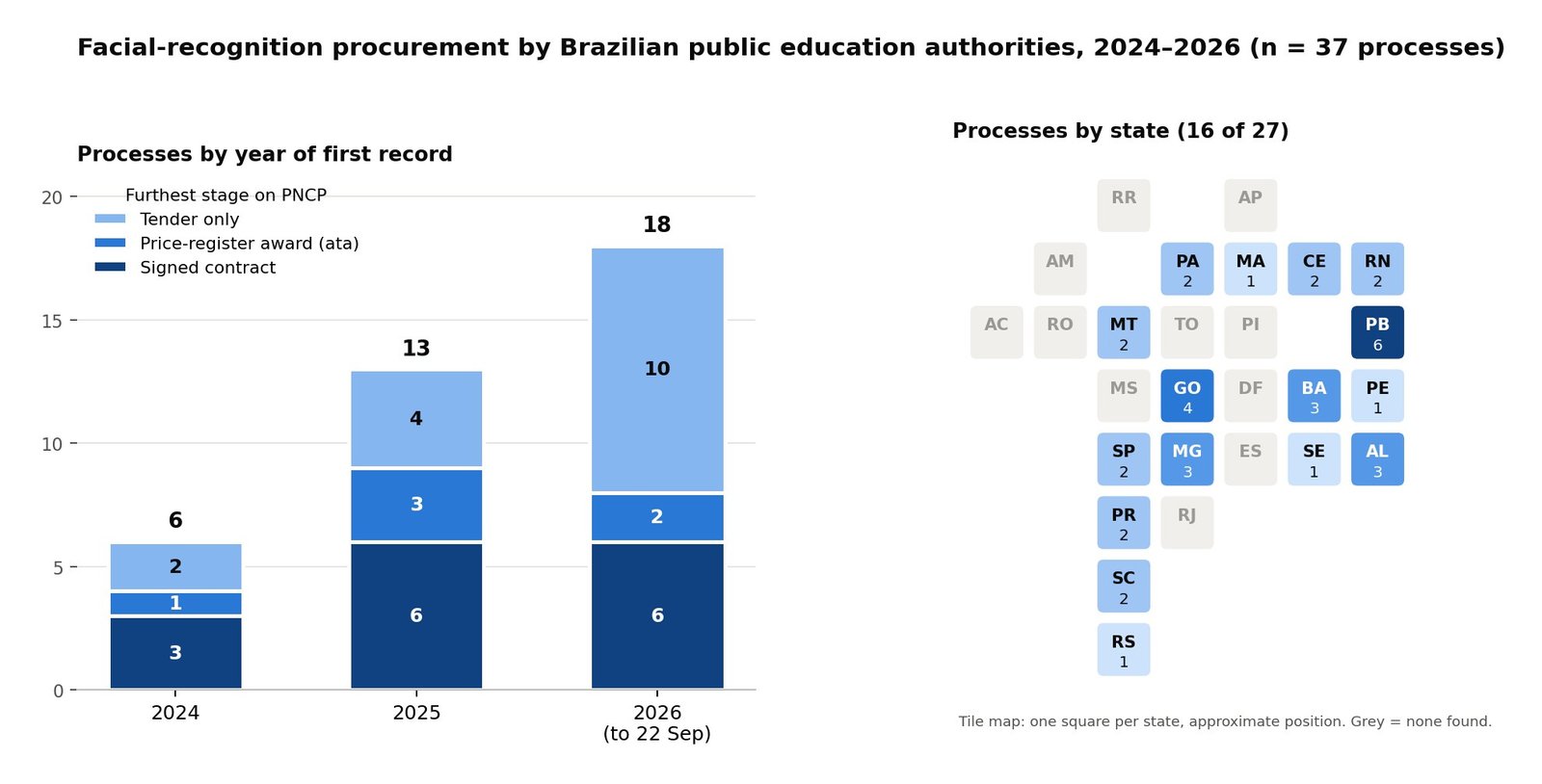
Intel Focus reviewed Brazil’s federal procurement portal, municipal tenders, regulatory and court records, and vendor material. It found at least 37 school facial-recognition purchases in 16 states since February 2024, tenders that leave storage and data transfers undefined, and Paraná’s data protection impact report and submissions to the regulator that show inconsistencies regarding who has access to these children’s images. The portal’s coverage is partial: until April 2027, Brazilian municipalities with up to 20,000 inhabitants may publish tenders only in official gazettes rather than on the portal, and purchases described in other words would not appear in the search. The 37 processes are therefore a minimum.
The Paraná order
Paraná, a southern state of 11 million people, had been scanning about 1 million public-school students’ faces since 2023 to record attendance. On 4 Aug. 2026, the National Data Protection Authority (ANPD) ordered the state education department and its contractors to stop ‘immediately’ and to disclose where the biometric databases were located. The order covered Paraná’s state schools only.
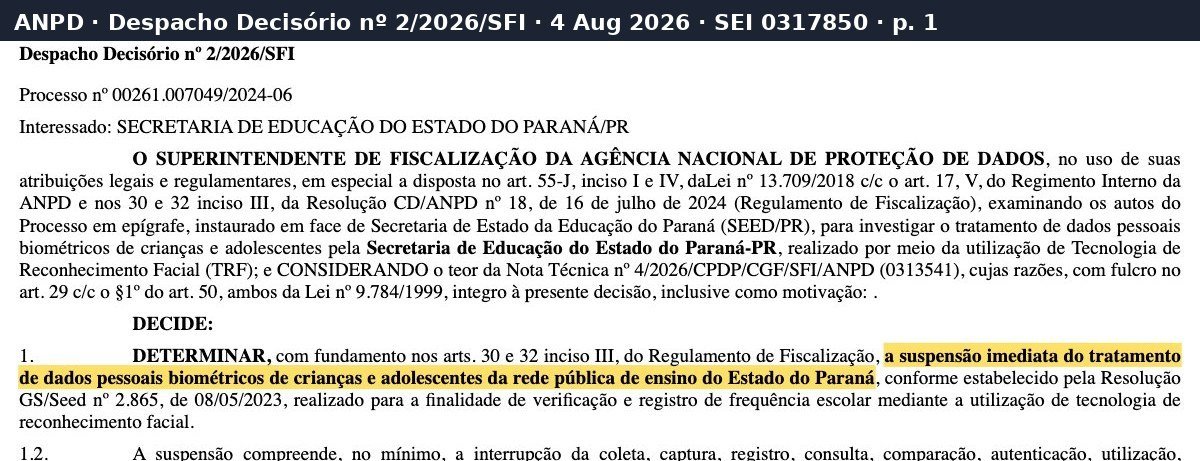
The order rested on a technical note that gave two reasons for the suspension. First, Paraná could not point to any law requiring it to collect children’s biometric data, which Brazilian law treats as sensitive. Second, the state’s own rules let teachers take attendance by hand, so scanning faces was unnecessary: ‘clearly disproportionate’, in the regulator’s words.
European software, a US cloud
Part of the technology used on children in Paraná comes from the European Union, where regulators have already limited facial recognition in schools. In 2019, Swedish Authority for Privacy Protection (IMY) fined a municipality over school facial recognition, ruling that pupils could not freely consent. France’s regulator found face-scanning gates at two high schools ‘neither necessary nor proportionate’; The Marseille Administrative Court declared the biometric system invalid under the General Data Protection Regulation (GDPR).
Paraná’s Personal Data Protection Impact Report: Facial Recognition (2021), as summarised in a May 2025 court decision, states that only Valid, its contractor, and Celepar, the state IT firm, would have access to students’ images. Yet Innovatrics, a Slovak biometrics company, says in its own case study that Valid ‘partnered with Innovatrics to provide the solution with facial recognition technology’ and that classroom photos ‘are then sent to Google Cloud Platform’ where faces are matched against a ‘watchlist’. The case study does not define the term, but it is likely the students’ enrolment photos: the app then lists ‘each identified student’ and marks them present or absent, and the ANPD says each pupil is photographed three times at enrolment. Although the state described access as limited to two companies, the setup links a European algorithm to a US cloud, with no stated location for data processing. Neither company is named in the publicly available Celepar–Valid contract or its third amendment, reviewed by Intel Focus on 22 Sept. 2026.
Procurement continued
In March 2026, Brazil’s Ministry of Education said, in a non-binding recommendation, that facial recognition in schools was ‘not recommended’. On 22–23 Sept. 2026, Intel Focus searched Brazil’s federal procurement portal, in Portuguese, for ‘facial recognition’ combined with ‘schools’, ‘pupils’, ‘students’, ‘education’, ‘daycare’, ‘school attendance’ and ‘municipal school network’, plus ‘facial school attendance’, ‘facial biometrics pupils’ and ‘facial-recognition school turnstile’. Counting each purchase once and keeping school-related processes from February 2024, it found 37 across 16 of Brazil’s 27 states: six in 2024, 13 in 2025 and 18 in 2026. 15 reached signed contracts, six price-register awards and 16 only the tender stage.
Purchases elsewhere carried on. Between 6 and 7 Aug. 2026, days after the Paraná order, Presidente Dutra (Maranhão) published a tender, while Canarana (Mato Grosso) and Bayeux (Paraíba) published contracts worth R$ 1.66 million (GBP 250,000).
Where school authorities bought facial recognition, Feb. 2024 – Sept. 2026
Where the data can go
The tenders leave open how far children’s biometric data can travel. Presidente Dutra’s tender applies to three types of data: students’ ‘foto facial’ (facial photo), taken by school staff on a smartphone and synced to the school scanners; enrolment records imported from the town’s school system; and absence reports that child-protection and social-assistance services can view. It also allows data to be sent to third-party systems and exported ‘for crossing with social programmes’, without saying what that data contains. Várzea Alegre’s tender sends unspecified data to the federal attendance database. Neither tender rules out that the data shared includes facial images.
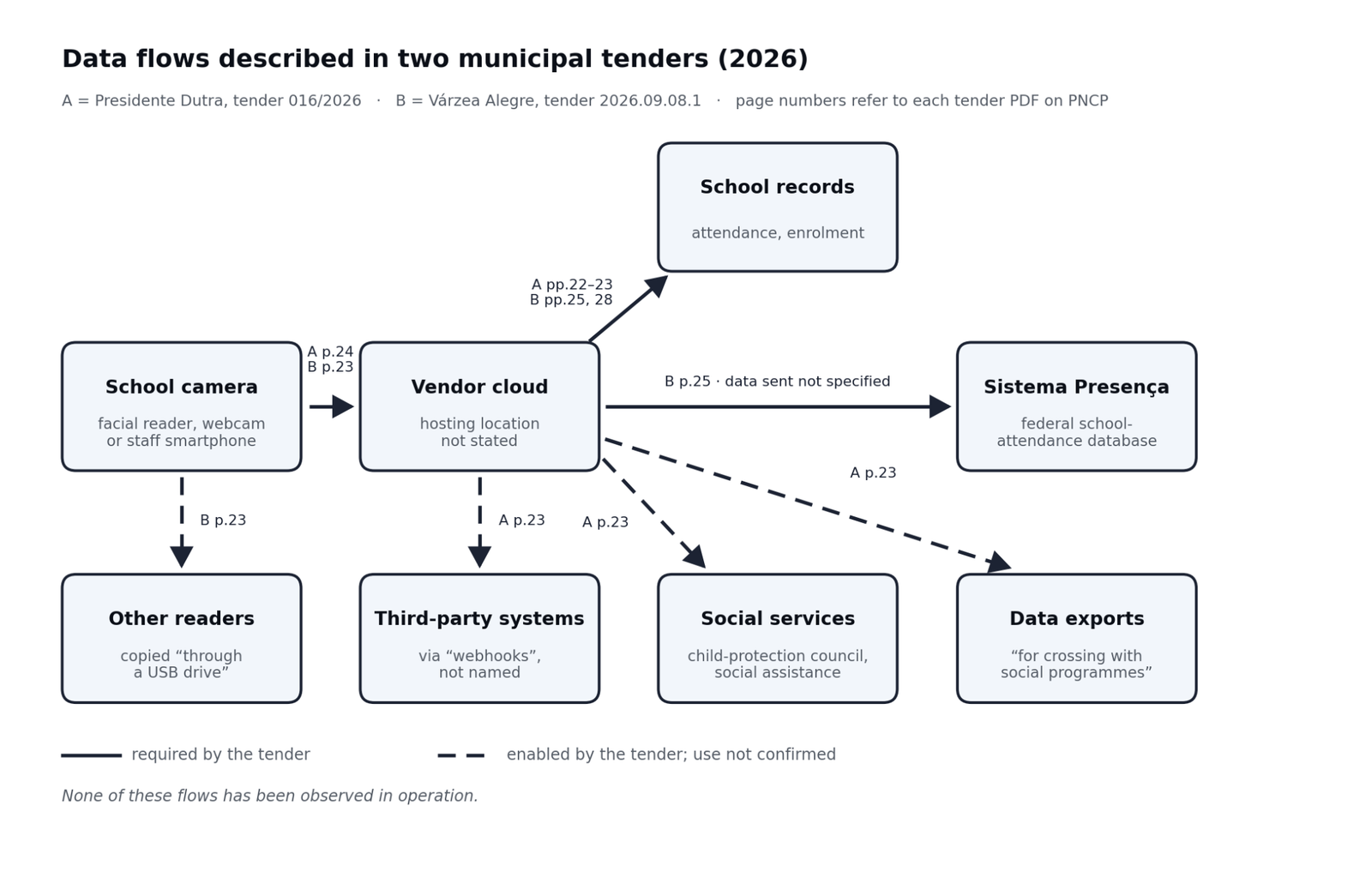
In Goiás, the state education department’s support page tells staff in 143 schools to copy students’ photos onto other devices by USB drive. Each copy creates another possible exposure point, and a face cannot be changed after a breach.
What the documents say
Teachers photograph students through a state app, Escola Paraná – Biometria, and Valid processes the images, according to the ANPD’s technical note. Paraná’s documents demonstrate inconsistencies regarding the data Valid receives. Its 2021 impact report, cited in a May 2025 court decision (p. 3), says Valid ‘will not receive any personal data’ identifying students; documents sent to the ANPD in February 2025 say Valid accesses each student’s image and enrolment code (technical note, §5.18). The app’s privacy policy permits transferring its data, including students’ photographs, to ‘public security’ bodies (§7.5); no such transfer is documented.
The data retention policy varies depending on the processor. The Celepar–Valid contract (GMS No. 4313/2022) bars Valid from keeping ‘real photos’ after processing (clause 12.1.1), but the ANPD found that the state has not shown how it verifies that the photos are deleted. The state keeps students’ facial photos in Celepar’s database for as long as they remain enrolled, according to the app’s privacy policy: up to 14 years per child, by the ANPD’s count, a possible ‘unnecessary risk’.
After the school gate
Paraná’s system ran for three years before Brazil’s National Data Protection Authority stepped in. In municipalities that signed contracts this year, the timeline for assessing their impact has only just begun. The children being scanned will change schools, graduate and grow up. The tenders do not say who will store their faces, for how long, or who is responsible for their biometric data once they leave.
Header image: Intel Focus editorial illustration, AI-edited from a photograph by Lucas Fermin / SEED-PR, via Agência Estadual de Notícias.
More investigations
View all
GTA VI tracks your crimes. What can that tell us about your playstyle?
You can shoot a stranger, rob a shop or pick a fight for the pleasure of seeing what…

The apps that watch you: how stalkerware enables tech-facilitated abuse
Apps sold as parental control let abusers read a partner’s messages, track their location and stay hidden. Intel…
How propaganda travels across borders and online platforms
A comparison of how pro-Taliban, pro-Russia, pro-China and pro-Iran networks produce and amplify propaganda, and how organic and…