How propaganda travels across borders and online platforms
Investigated and authored by: Aidan Sanderson
Edited by: Sindre Langmoen
This report examines and compares recent examples of how pro-Taliban, pro-Russia, pro-Iran and pro-China networks produce and amplify propaganda to promote political narratives and influence online audiences. It focuses particularly on how organic and coordinated amplification networks redistribute such content across platforms and national boundaries.
Pro-Taliban influence operations
During the 2026 Afghanistan-Pakistan conflict, numerous AI-generated or manipulated videos circulated across social media and were shared by both pro-Taliban and pro-Pakistan actors.
For example, an apparently AI-generated video emerged in March 2026, aimed at undermining the Pakistani military. The video shows a person wearing a Pakistani military outfit, wearing the Pakistani flag, struggling while tangled in barbed wire by the border, calling out for help. It has been reposted by many accounts and posted across various social media platforms to reach a broad audience.
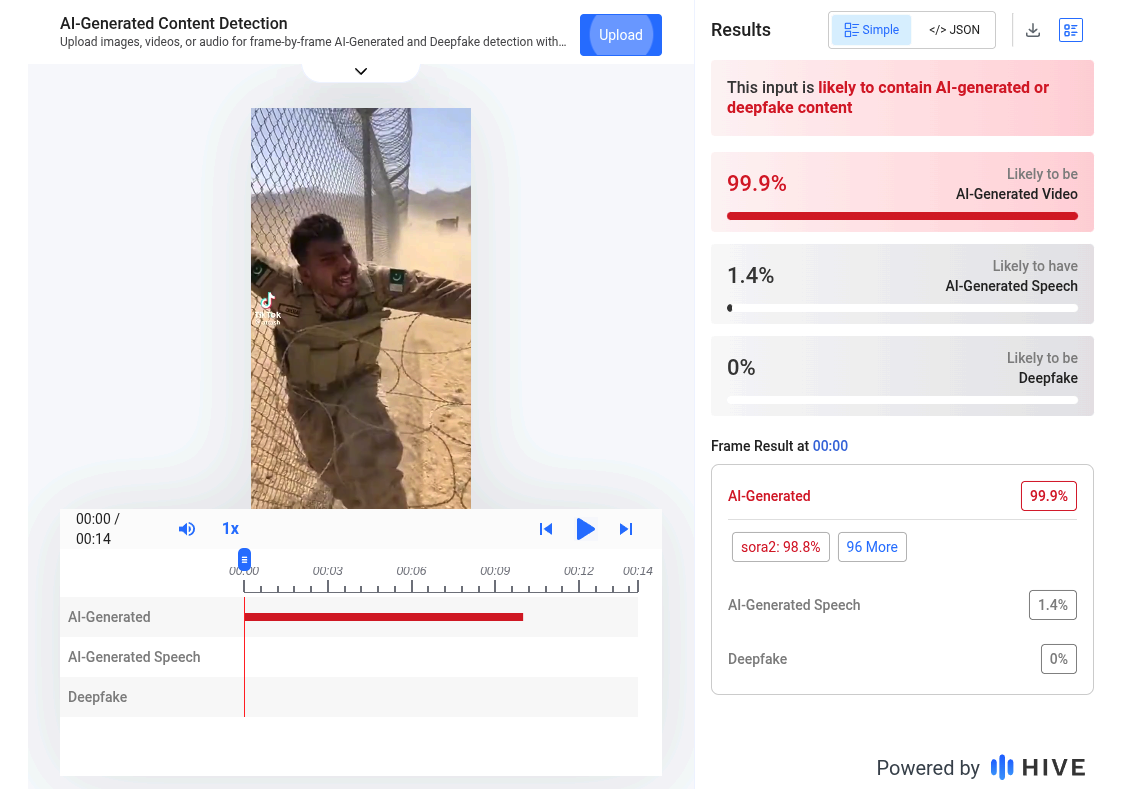
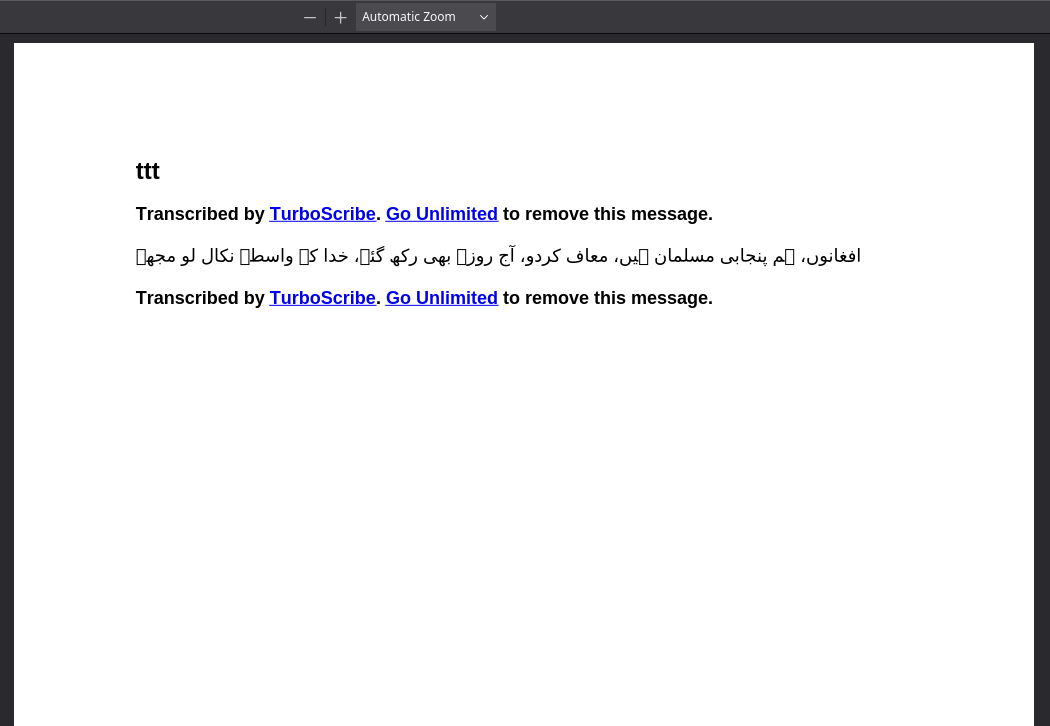
Analysis of the video using Hive shows a high degree of likelihood of the video being AI generated. The audio track was extracted from the video and transcribed using Turboscribe. The language used in the video speech translated to “Afghans, I am a Punjabi Muslim, forgive me, keep this day as well, for God’s sake, take me out.” in English.
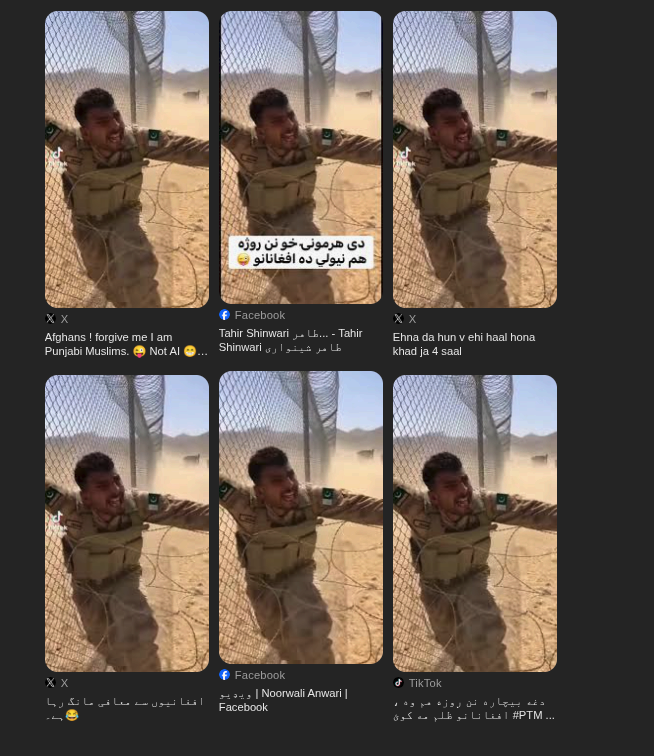
Reverse search analysis shows that the video was likely first posted on TikTok on March 9, 2026, by an account with 35.7k followers. This account has produced another AI-generated video showing a similar scene, and multiple other AI-generated videos showing other topics. The account explicitly states support for the Pashtun Tahafuz Movement (PTM), a movement advocating for Pashtun rights in Pakistan. PTM is not aligned with the Taliban.
The video was then shared by different accounts over different platforms in a short time, with multiple copies appearing on X, Instagram and Facebook on March 10 and 11. In this case, we found no evidence indicating coordinated distribution. The available evidence suggests that the video was generated by an independent actor and spread organically. This example shows the power of rapid redistribution across multiple platforms.
Other pro-Taliban influence groups
On the other hand, several other Afghanistan-based groups reportedly conduct similar online influence operations. Afghanistan International has identified three Pro-Taliban groups, the “Badri Virtual Devotees,” “Ababil Emarati,” and “Omari Defenders,” that create and share content on Facebook and X defending Taliban officials, countering criticism and attacking political opponents. According to the outlet, these groups are reportedly led by or associated with high-ranking Taliban members, including Minister of Interior Sirajuddin Haqqani, Minister of Defence Mohammad Yaqub Mujahid and intelligence chief Abdul Haq Wasiq.
Afghanistan International reported that the “Badri Virtual Devotees” operates from multiple locations in Kabul, with 150 members divided into 15 groups, and manages around 500 Facebook accounts and 800 accounts on X. The outlet also claimed that the Ababil Emirati group, which it described as affiliated with the Taliban intelligence services, hires hackers from Pakistan to monitor and attack the Taliban’s political opponents on social media.
The “Omari Defenders” group, meanwhile, is reportedly associated with Taliban Defence Minister Mullah Yaqub. According to Afghanistan International, the group includes about 100 employees and is led by a former Afghan radio and television journalist. Its members reportedly promote Pro-Taliban narratives online and seek to project a positive image of the movement.
These Afghan groups primarily create and amplify content promoting pro-Taliban narratives, countering criticism and targeting political adversaries. Their activities largely focus on domestic and regional political narratives.
Interconnected pro-Russia, pro-China and pro-Iran operations
Meanwhile, the Russia, China and Iran-aligned networks examined in this report focus more heavily on narratives targeting Western foreign policy. Some also promote and amplify content produced by actors aligned with other countries, reinforcing overlapping narratives critical of the West.
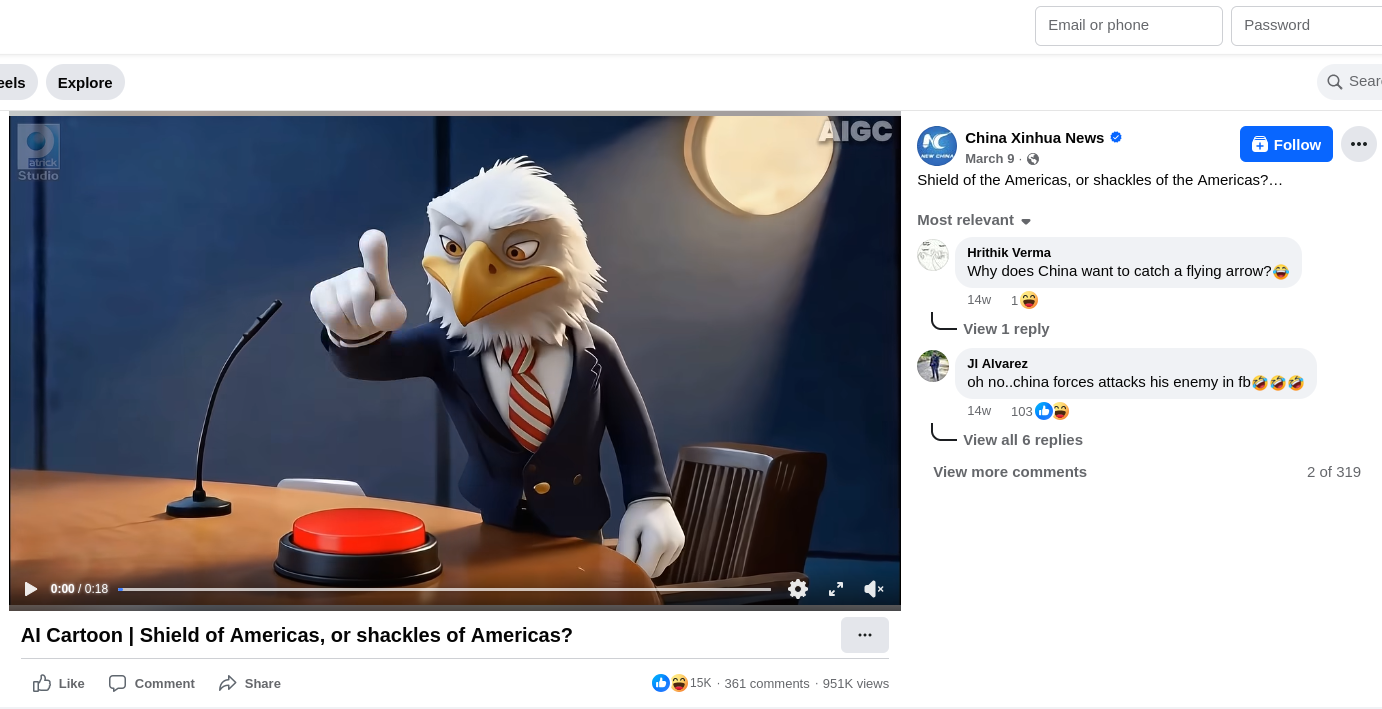
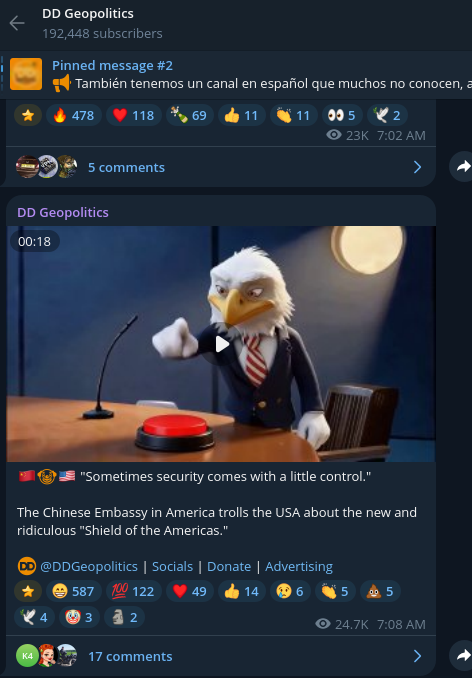
“DD Geopolitics,” for example, is a network of pro-Russian propaganda accounts with a very high citation index, which has found its place in the information space. “DD” stands for “Donbas Devushka”, which translates to “Donbas girl.”
The main force of active viewers of the channel is men and, unexpectedly, an audience interested in political blogs in Iran, India, Ukraine, and others. The person behind this group is associated with Donbas Devushka.
For example, the DD-Geopolitics shared Chinese propaganda content watermarked “Patrick Studio” were generated by journalist Zheng Jinqiang from Xinhua News Agency in cooperation with its Technology Bureau. He appeared as a man from a James Bond parody. His social media accounts are identified as distribution platforms for the “Zheng Jinqiang Media Studio,” which was established in 2021.
The Donbas Devushka account was exposed in 2023 by reporters and members of the online “NAFO” pro-Ukrainian movement, and the person behind the pro-Russian account turned out to be an American woman and ex-Navy noncommissioned officer named Sarah Bills. Neither the account nor the person behind it appears to be directly affiliated with or coordinating with Russia.
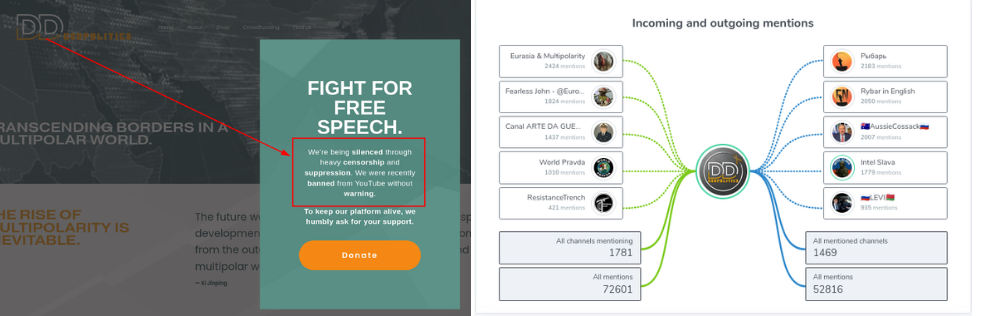
Though acting independently, DD Geopolitics has appeared to play a role in centrally coordinated Russian influence operations. According to DFRLab, DD Geopolitics acts as both a content source and as an amplification node in the Storm-1516 ecosystem, a documented propaganda group that targets Western information environments and has documented links to known influence actors close to the Kremlin.
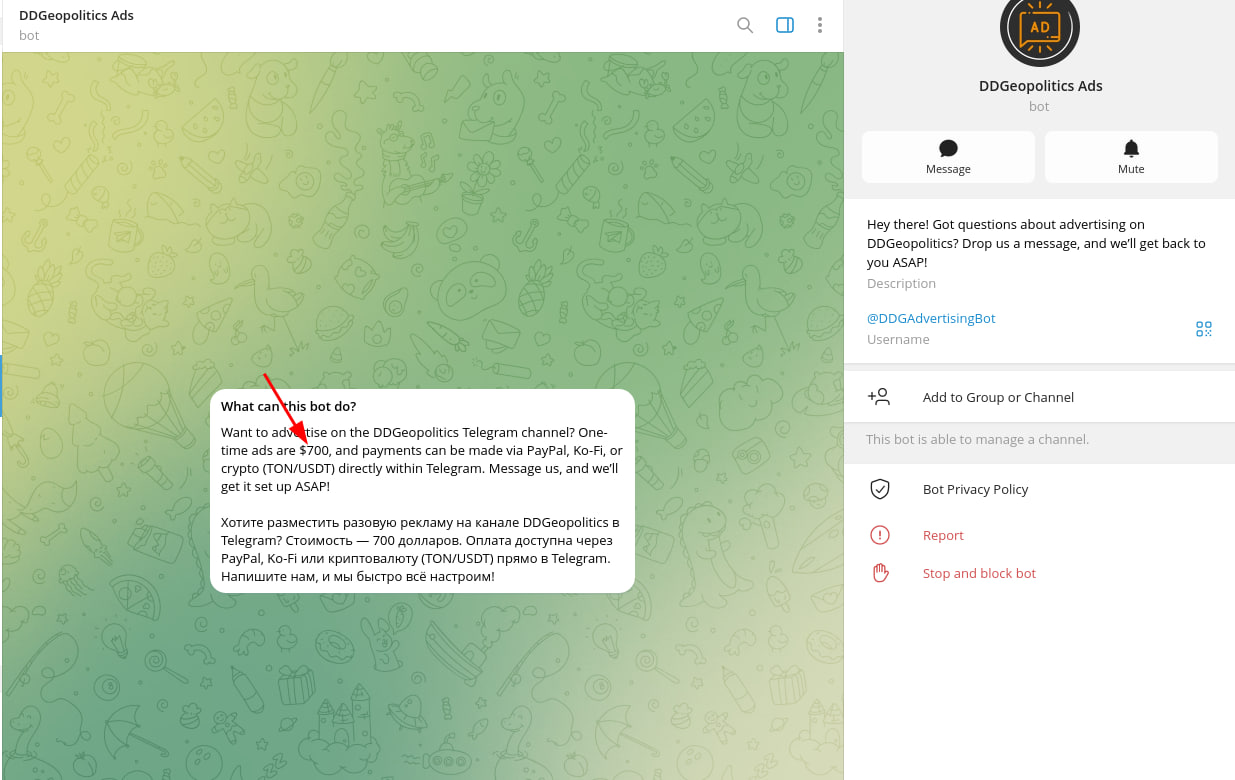
DD Geopolitics asks for donations, sells online merch, and offers the opportunity to place advertisements on their channel in order to fund their operations. DD Geopolitics previously stated that their YouTube channel was banned, but it remains accessible at the time of writing.
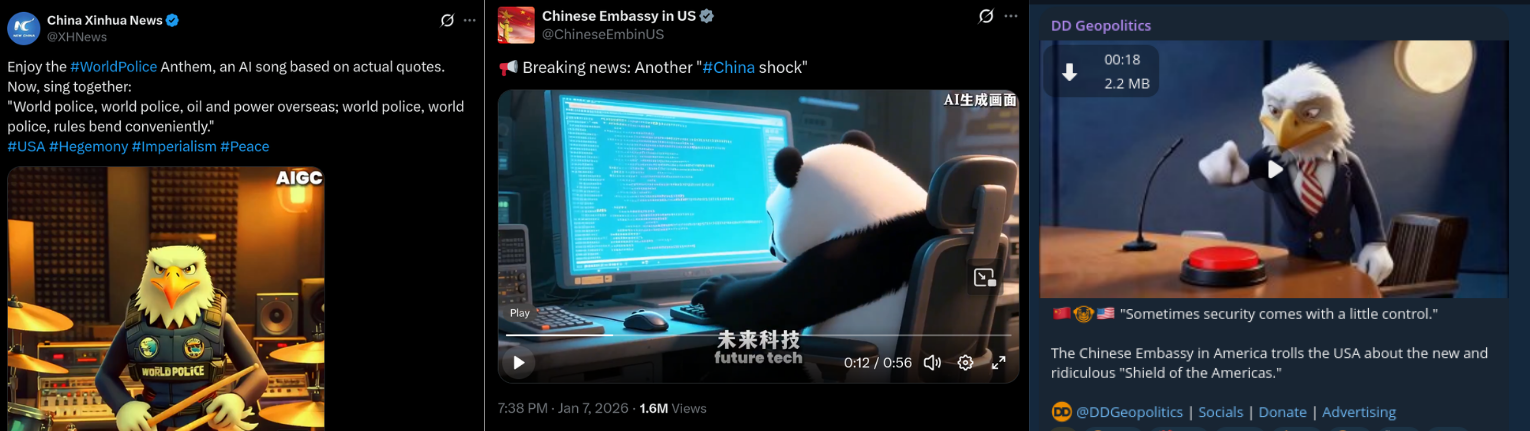
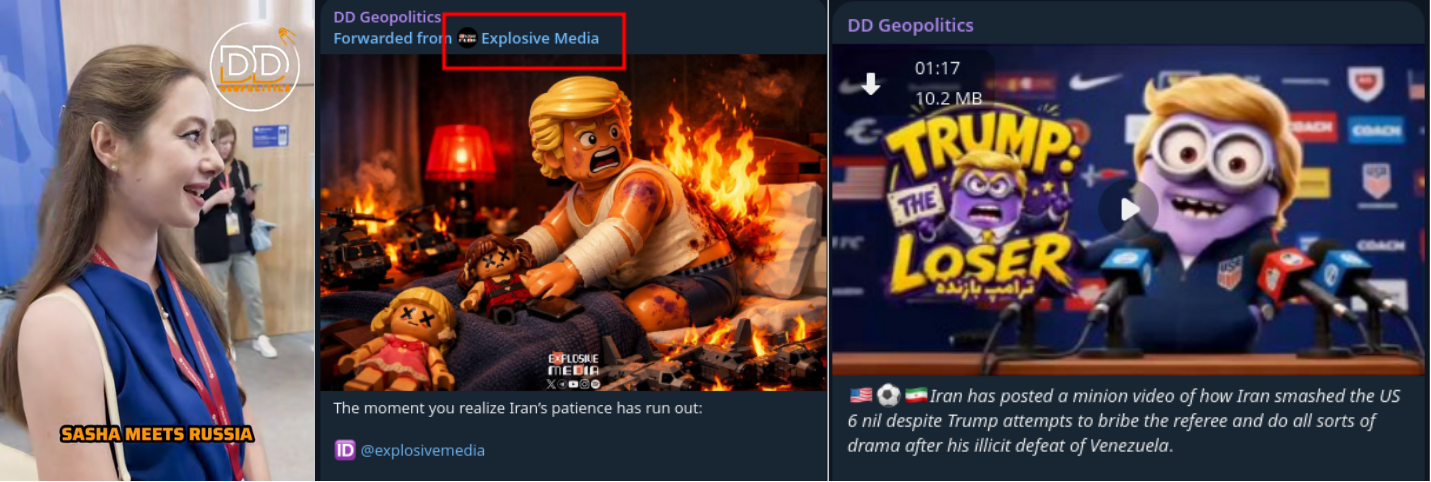
In addition to amplifying Chinese-made propaganda content, DD Geopolitics also disseminates other pro-Iran influence actors such as the AI media creators “Explosive Media” or “thewartoon”, as well as other pro-Russian content creators such as the “Sasha meets Russia” account.
During the 2026 U.S and Israeli “Operation Epic Fury” military campaign against Iran, the information warfare groups from China, Russia, and Iran stepped up their disinformation campaign. They amplified each other’s propaganda content by resharing them in their network channels on Telegram.
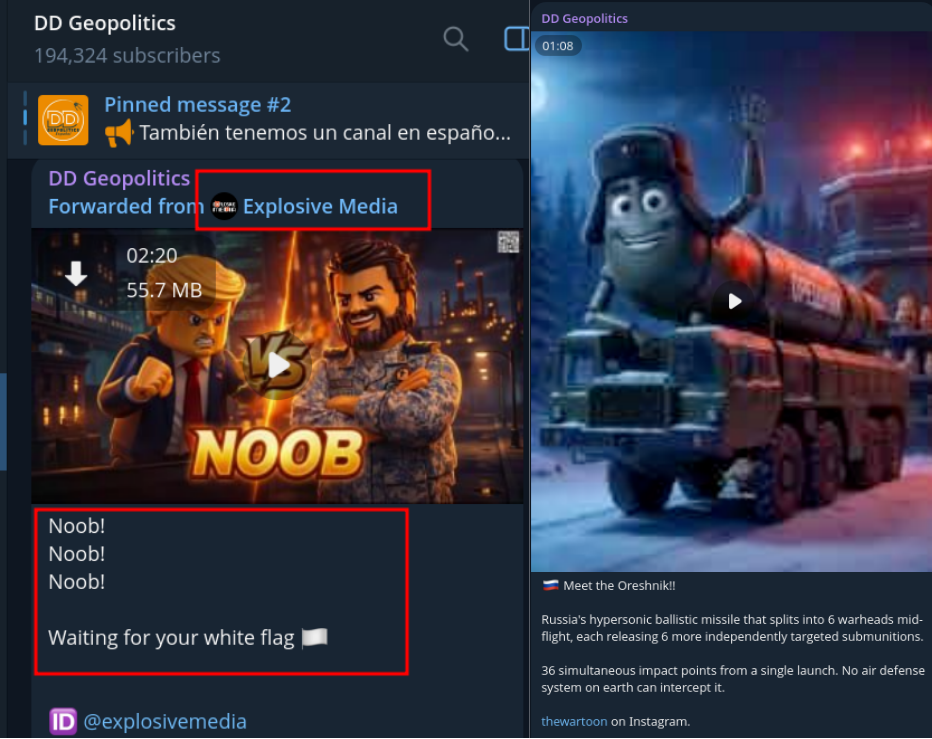
The Explosive Media group has been alleged to be directly associated with the Iranian government, an allegation that the group itself denies. However, in a BBC interview, a representative of the group has admitted that it is a customer of the Iranian government. The group has reached a wide audience on social media by distributing the LEGO-style propaganda videos, mocking the US military operations in Iran, which went viral.
Explosive Media’s YouTube channel has been blocked by the platform. However, other accounts of the group on Telegram, Meta platforms, X (Twitter) and TikTok are still active.
Comparison: Taliban, Russia, China and Iran
A key distinction among the networks examined in this report is their strategic focus. The pro-Taliban networks studied here are largely inward-facing, promoting Taliban narratives, countering political opponents and seeking to influence domestic and regional audiences. By contrast, the Russia-, China- and Iran-aligned networks examined here more frequently target international audiences and promote narratives critical of Western policies.
Despite these differing objectives, these groups share a common methodology, utilising similar tactics and infrastructures for disseminating propaganda. The financing models for these groups are diverse. Some operate through decentralised networks, utilising Telegram bots to solicit donations, which are most likely processed via cryptocurrency to maintain anonymity and circumvent traditional financial oversight. Disinformation and propaganda networks are better from financial resources, networks, strong social reach, coordinated structures and communication strategies.
Why it is difficult to combat influence operations
Countering influence operations presents a structural challenge. Producing and rapidly distributing misleading content can require relatively limited resources, while verification often involves source tracing, technical analysis, attribution and ethical review. This imbalance allows well-established amplification networks to distribute narratives more quickly than researchers, journalists and fact-checkers can investigate and respond to them.
More investigations
View all
The apps that watch you: how stalkerware enables tech-facilitated abuse
Apps sold as parental control let abusers read a partner’s messages, track their location and stay hidden. Intel…
Insurgent attacks in southern Thailand: geolocation and analysis
Nine attackers, ninety seconds and two CCTV cameras. Intel Focus geolocates the checkpoint ambush that killed five Thai…
Former Afghan parliamentarian extradited to the US
A former Afghan general, member of parliament and First Deputy Speaker of the House has been extradited from…