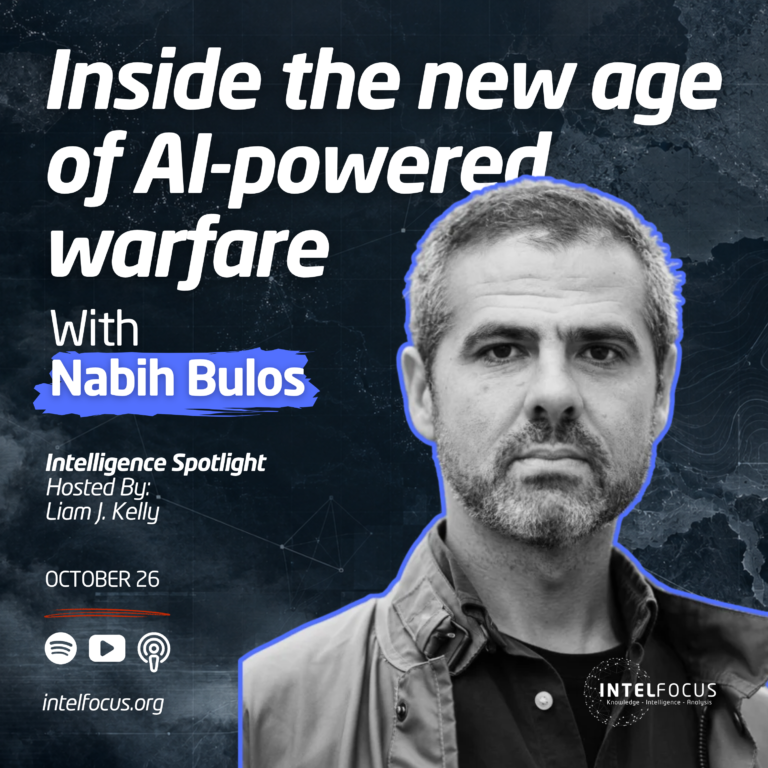
From AI-assisted targeting and mass surveillance to autonomous drones and synthetic propaganda, artificial intelligence is transforming modern warfare. But as the battlefield becomes increasingly automated, journalists face a growing challenge: establishing what actually happened.
In the latest episode of The Intelligence Spotlight, Liam J. Kelly speaks with Nabih Bulos, Middle East Bureau Chief of the Los Angeles Times, about how artificial intelligence is changing the conduct of war, the collection of intelligence and the ability of journalists to report from conflict zones.
Having reported from Syria, Iraq, Yemen, Lebanon, Sudan and Ukraine, Nabih has witnessed the evolution of modern warfare first-hand. His career began unexpectedly in Beirut, where he worked as a concert violinist before becoming a translator and eventually a war correspondent.
A battlefield without safe margins
For Nabih, one of the most consequential changes is the growing difficulty of reaching the front line.
During the battle against Islamic State in Mosul, journalists could accompany advancing troops and operate within a relatively predictable margin of risk. Today, the proliferation of drones and increasingly sophisticated surveillance networks has fundamentally altered that calculation.
In Ukraine, surveillance and strike capabilities can extend kilometres beyond the conventional front line, making movement increasingly dangerous for soldiers and journalists alike.
The consequences extend beyond personal safety. When correspondents cannot physically reach combat positions, they lose access to the atmosphere, experiences and human realities that give frontline reporting its depth.
When data becomes a weapon
The conversation examines how militaries use AI to process enormous quantities of intelligence, combining satellite imagery, communications data, surveillance footage and behavioural patterns to identify potential targets.
Nabih traces elements of these developments back to earlier machine-learning applications in Afghanistan and examines how AI-assisted intelligence systems have featured in Israeli military operations.
He discusses the use of digital footprints to identify individuals and the implications of systems capable of analysing movements, communications and associations at scale.
However, the ability to identify potential targets raises difficult questions about accuracy, civilian casualties and accountability.
Nabih questions the reliability of automated assessments and argues that responsibility extends beyond military commanders to the technology companies supplying the infrastructure and systems underpinning modern warfare.
The crisis of verification
Artificial intelligence is not only transforming military operations. It is also changing the information environment surrounding conflicts.
AI-generated photographs, videos and coordinated influence campaigns are creating new obstacles for journalists, open-source investigators and human rights researchers.
Nabih warns that increasingly convincing synthetic material could undermine confidence in digital evidence, while artificially amplified online narratives may distort perceptions of public opinion.
For open-source intelligence investigations, which often rely on satellite imagery, geolocation and publicly available videos, the challenge is particularly significant.
The growing sophistication of synthetic media means that even apparently convincing visual evidence may require extensive independent verification.
Returning to the fundamentals of journalism
Despite these technological developments, Nabih believes the future of credible conflict reporting depends on principles that predate artificial intelligence.
Journalists must spend more time corroborating information, develop trusted networks of sources and maintain direct relationships with people on the ground.
As information becomes easier to produce and manipulate, establishing its authenticity may become increasingly difficult.
The central paradox emerging from the conversation is that AI can make intelligence gathering faster and more comprehensive while simultaneously making independent verification more demanding.
For Nabih, the answer is not simply better technology, but stronger journalism.
Editor’s note
At approximately 25:34, discussing AI-assisted targeting and civilian casualties, Nabih Bulos states: “if there are 20 people killed or 40 people killed who are collateral damage, that’s an acceptable ratio.” He presents this as an example of the decisions he believes Israeli military operators make when determining acceptable civilian casualties.
The Israeli military rejects allegations of this kind. It says every strike requires an individual assessment of the expected harm to civilians, approved by an operational commander, and that Hamas and Hezbollah deliberately operate from civilian areas.
Sources:
- IDF, “The IDF’s Use of Data Technologies in Intelligence Processing” (published 18 June 2024, updated 19 October 2026).
- IDF Spokesperson, “Why the IDF Is Operating in Lebanon Today” (8 March 2026).
- IDF Spokesperson, response to the film NAZA (11 September 2026).
Guests’ views are their own. Intel Focus welcomes responses from any party discussed in our episodes: info@intelfocus.org
More episodes
View all
How to think like an intelligence analyst | John Hall
The rapid growth of open-source investigation has blurred the boundaries between journalism, intelligence and publicly available information. For…
Why journalism is national security | Olivia Pirie-Griffiths
Journalism is facing more than a crisis of funding or trust. For Olivia Pirie-Griffiths, the pressures confronting journalism,…

“These values are not idealistic”: can the EU still defend its principles? | Dr Berit Ebert
Spotify content is blocked This embed would set cookies from a third party, so we only load it…