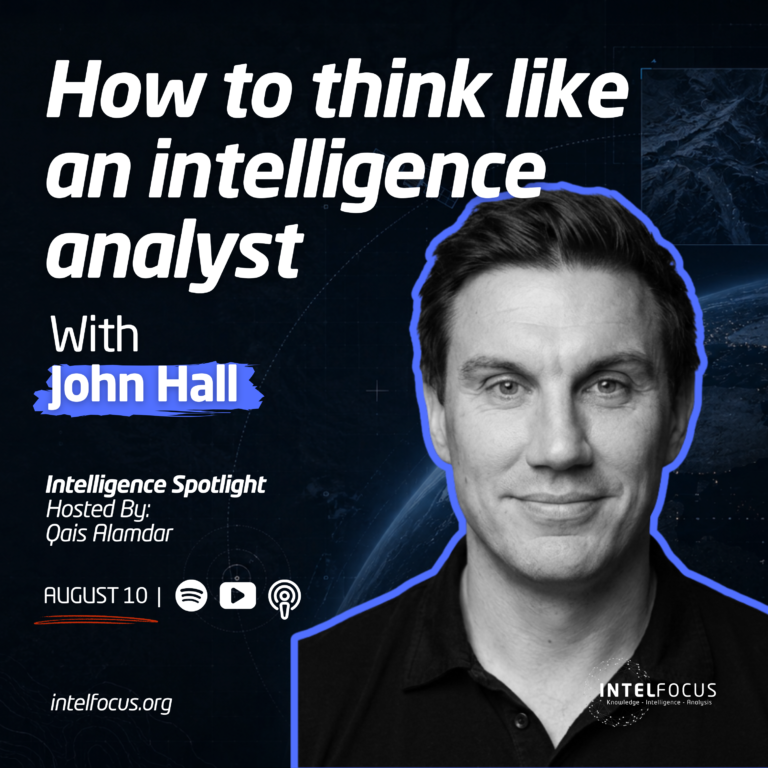
The rapid growth of open-source investigation has blurred the boundaries between journalism, intelligence and publicly available information. For John Hall, a former British Army officer now working in intelligence and commercial satellite imagery, that distinction matters.
Speaking to The Intelligence Spotlight, Hall argued that the term OSINT has become “hugely overused” and is often applied to activities that may involve open sources but do not necessarily constitute intelligence.
“The bit at the beginning is the source, i.e. OS, and the bit at the end implies it’s intelligence,” John said. “At times it’s not open source, and at times it’s not intelligence.”
He suggested returning to basic principles when assessing information.
“What is the source of that intelligence?” he asked. “If the source of that intelligence is a human, then let’s call it human, because that allows us to assess it properly.”
John also distinguished investigative journalism and intelligence analysis. While their methods can look remarkably similar, he said their objectives are fundamentally different.
“A journalist conducting an investigation, a lawyer researching a situation for their client, and an intelligence operator trying to do a threat report might look very, very similar on the surface,” he said. “The methodology, the tactics of it are incredibly similar. But the output is fundamentally different.”
For John, investigation is generally concerned with understanding what has already happened, while intelligence is more concerned with what may happen next.
“You have to understand the past in order to understand the future,” he said, “but you’re focused on what is going to happen.”
That distinction also affects how information is shared.
“Journalism by its very nature is about bringing something to the public attention,” John said. “Intelligence, by its very nature, tends to be about having some type of advantage over someone.”
The conversation also examined how satellite imagery has changed conflict analysis, particularly during Russia’s war against Ukraine.
John described Ukraine as an unusual conflict in which modern commercial intelligence capabilities are being applied to what remains, in many respects, a conventional war.
“You’ve got armour rolling across open fields and open countryside, you’ve got artillery strikes, you’ve got missile strikes,” he said. “These are all things we’re expecting in the 1950s, and these are things that are happening in the 2020s.”
But as AI makes manipulated imagery increasingly convincing, John believes trust may depend less on what an image appears to show and more on who stands behind it.
“Your imagery being accurate, your imagery being correct, shall we say, is going to be a brand issue going forward rather than a data issue,” he said.
His advice to those entering intelligence, OSINT or investigative journalism was considerably simpler.
“There is a phrase which anyone who has been through military intelligence training will be very familiar with, which is: so what?”
“It’s very easy to say what has happened,” John said. “It’s very difficult to say what does that mean.”
For John, that is where information begins to become intelligence.
More episodes
View all
Why journalism is national security | Olivia Pirie-Griffiths
Journalism is facing more than a crisis of funding or trust. For Olivia Pirie-Griffiths, the pressures confronting journalism,…

“These values are not idealistic”: can the EU still defend its principles? | Dr Berit Ebert
Spotify content is blocked This embed would set cookies from a third party, so we only load it…
Can the youth of Afghanistan shape the future of AI? | Zia Yousufi
Afghanistan is often discussed through the language of conflict, collapse and restriction. What gets far less attention is…