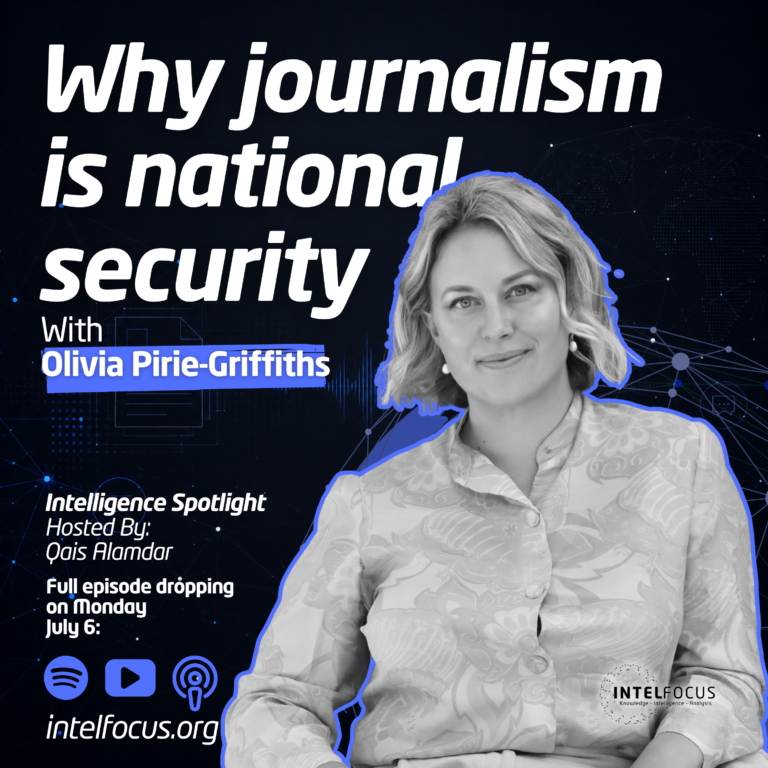
Journalism is facing more than a crisis of funding or trust. For Olivia Pirie-Griffiths, the pressures confronting journalism, national security and the wider information environment are increasingly interconnected.
Speaking on The Intelligence Spotlight, Pirie-Griffiths described information integrity as “the strength and resilience of the systems of communication that depict, explain and challenge our democracies and societies”. Fact-checking, counter-disinformation and media literacy, she argued, are all parts of this much broader system.
Her path into the field began with philosophy, but a defining moment came through the imprisonment of Al Jazeera journalist Peter Greste in Egypt. She later became executive director of the Alliance for Journalists’ Freedom, founded after Greste’s release.
“If we don’t have systems of information in our democracies that we can trust, then we can’t actually solve any issues,” she said, describing the experience as one that “really sort of lit a flame” for her work in press freedom.
At the Centre for Information Resilience, including through its Afghan Witness project, Pirie-Griffiths worked with Afghan journalists, diaspora communities and organisations operating in difficult information environments.
One of her main lessons was the importance of avoiding approaches based on the assumption that “the West knows best”.
“The best journalism and OSINT always happens collaboratively,” she said, particularly when investigators work with people who understand the country, culture and information environment they are investigating.
But the information environment itself is changing.
“We live in an attention economy,” Pirie-Griffiths said, arguing that technology platforms profit from attention while algorithms can increasingly direct people towards more extreme information silos. With AI, she warned, this relationship may evolve further into what has been described as an “attachment economy”.
For journalism, the consequence is both a crisis and a transition.
“Journalism doesn’t sit on an island,” she said. “It’s a crisis of democratic institutions. It’s a crisis for our democracies as a whole.”
That also means journalism and national security cannot simply treat each other as adversaries.
“National security and journalism are inherently connected,” Pirie-Griffiths argued. Security laws may be necessary, but without protections for journalism and the public’s right to know, they risk “stifling the democracy that they supposedly seek to protect”.
Her concern ultimately returns to who controls the infrastructure through which societies receive information.
“If we continue to allow tech companies to pursue profit above all else,” she warned, “we will continue to see our democratic systems be undermined.”
More episodes
View all
How to think like an intelligence analyst | John Hall
The rapid growth of open-source investigation has blurred the boundaries between journalism, intelligence and publicly available information. For…

“These values are not idealistic”: can the EU still defend its principles? | Dr Berit Ebert
Spotify content is blocked This embed would set cookies from a third party, so we only load it…

Can the youth of Afghanistan shape the future of AI? | Zia Yousufi
Afghanistan is often discussed through the language of conflict, collapse and restriction. What gets far less attention is…